1. Introduction
In the context of green transition and greenhouse gas (GHG) emission reduction objectives, many enterprises have applied and continue to apply energy-saving and operational optimization solutions to move toward sustainable development. This article summarizes several representative enterprise models and the successful case of HLD production & trading company limited.
2. Practical case: HLD – operational optimization and emission reduction
Enterprise overview: HLD production & trading company limited was established in 2015 and operates mainly in the fields of mechanical processing, metal treatment, and metal coating. Throughout its operation, HLD has continuously pursued innovation and applied modern technological solutions to improve production efficiency and reduce environmental impacts.
GHG emission reduction strategy: Recognizing the importance of GHG emission reduction, HLD has set specific objectives and measures:
- Objective: By 2025, reduce total scope 1 and scope 2 GHG emissions by 5.7% (equivalent to 15.3 tonnes of CO₂e) compared with 2023.
- Implemented initiatives:
- Conversion of cooking equipment from gas to electricity, reducing CO₂e emissions.
- Reduction of fuel consumption for truck operations by 20% through vehicle maintenance and transport optimization.
- Use of environmentally friendly welding gas and provision of welding technique training for workers.
- Installation of solar panels for lighting systems and optimization of natural lighting in workshops, reducing electricity consumption by 5.1%.
Achieved results: Through these measures, HLD is expected to reduce:
- 15.3 tonnes of CO₂e greenhouse gas emissions.
- 597 kWh of electricity consumption.
As a result, the enterprise not only reduces environmental impacts but also achieves operating cost savings and enhances competitiveness.
3. Conclusion
The successful case of HLD clearly demonstrates that greenhouse gas inventory activities and the application of emission reduction solutions not only contribute to global environmental protection but also generate dual benefits for enterprises. Other enterprises can fully learn from and apply similar solutions to achieve sustainable development objectives.
Related Articles

Capacity building and promoting the Digital and Green Transformation for SME support units in Quang Tri

STI Vietnam co-organizes capacity building for SME support units in Thai Nguyen

STI Vietnam co-organizes in-depth training on the digital and green transformation for SME support units in Hanoi

STI Vietnam co-organizes training on the digital and green transformation for SME support units in Hai Phong
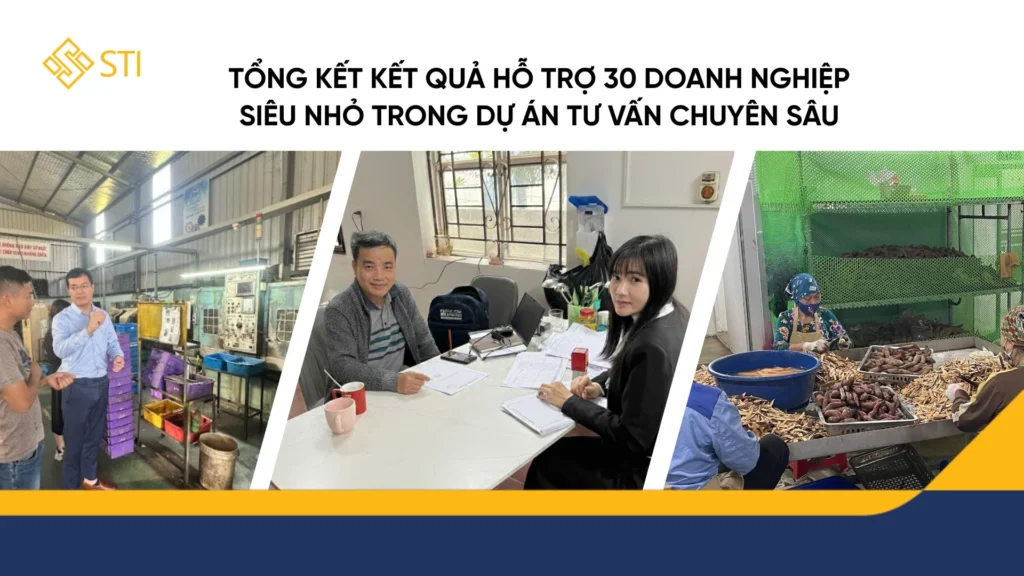
Project Outcomes: In-depth Consultancy Support for 30 Micro-enterprises