



ISO 22301 – Business continuity management system
In a business environment that is constantly exposed to risks and disruptions—from natural disasters and pandemics to technological incidents and supply chain interruptions—organizations need effective management solutions to maintain stable operations. ISO 22301 – Business continuity management system is the international standard that helps organizations establish, operate, and improve their resilience to crises. Implementing and achieving ISO 22301 certification not only supports businesses in rapidly recovering from incidents but also protects brand reputation, maintains customer trust, and ensures sustainable long-term development.
What is ISO 22301?
ISO 22301 is the international standard for Business Continuity Management Systems (BCMS), issued by the International Organization for Standardization (ISO). It provides a framework for organizations to plan, implement, operate, monitor, and improve management systems in order to protect against and reduce risks arising from business disruptions.
The current version, ISO 22301:2019, follows the high-level structure of Annex SL, enabling easy integration with other ISO management systems such as ISO 9001 and ISO 27001. The standard requires organizations to define their operational context, assess risks and opportunities, establish objectives, implement response and recovery processes, and conduct performance evaluation and continual improvement. Applying ISO 22301 helps enhance resilience, minimize financial losses, and maintain the confidence of customers, partners, and stakeholders in all situations.

From the above concept, it can be seen that ISO 22301 does not only set out requirements, but also provides a comprehensive framework to help organizations build and operate a business continuity management system (BCMS). To better understand this, it is necessary to examine the core components of a BCMS.
- Policy
- Competent personnel with clearly defined responsibilities
- Management processes related to:
- Policy
- Planning
- Implementation and operation
- Performance evaluation
- Management review
- Continual improvement
- Documented information to support operational control and enable evaluation of performance effectiveness.
However, understanding these components is only the first step. What is more important is understanding why ISO 22301 is necessary in a context where businesses face constant change and risk.
Why is ISO 22301 important?
ISO 22301 is important because it helps organizations establish and maintain a business continuity management system (BCMS) to minimize risks and ensure uninterrupted operations. The standard requires organizations to clearly identify needs and establish specific policies and objectives to guide management activities. As a result, organizations can operate and maintain processes, capabilities, and response structures to sustain operations even during incidents. Monitoring and evaluating BCMS effectiveness helps identify weaknesses in the system, providing a basis for improvement. When this process is carried out regularly, organizations enhance their resilience, protect brand reputation, and maintain customer trust in a highly volatile competitive environment.
Clearly, this standard provides a solid foundation for risk management. However, ISO 22301 is not only necessary for large corporations. So, which types of organizations are best suited to implement this standard?
Which organizations is ISO 22301 suitable for?
ISO 22301 is a widely applicable standard that can be implemented by any type of organization or by individual departments within an organization, regardless of size or industry. However, the level of implementation and degree of detail depend on the business context, operating environment, and complexity of each organization’s supply chain.
In practice, organizations operating in critical service sectors such as banking, insurance, healthcare, telecommunications, information technology, energy, transportation, and logistics are often recommended to apply ISO 22301, as the continuity and stability of their operations directly impact society and the economy. Organizations with multiple branches, extensive distribution systems, or heavy reliance on technological infrastructure also greatly benefit from this standard to reduce disruption risks.
In addition, organizations seeking to enhance brand reputation and meet stringent requirements from international partners and customers will find significant value in implementing ISO 22301. As such, this standard is suitable not only for large corporations but also for small and medium-sized enterprises with a sustainable development orientation and a desire to build resilience against crises.
Benefits of applying ISO 22301
Implementing a BCMS in accordance with ISO 22301 not only helps organizations maintain operations during disruptions but also creates sustainable strategic value. A well-structured business continuity management system delivers benefits across multiple dimensions:
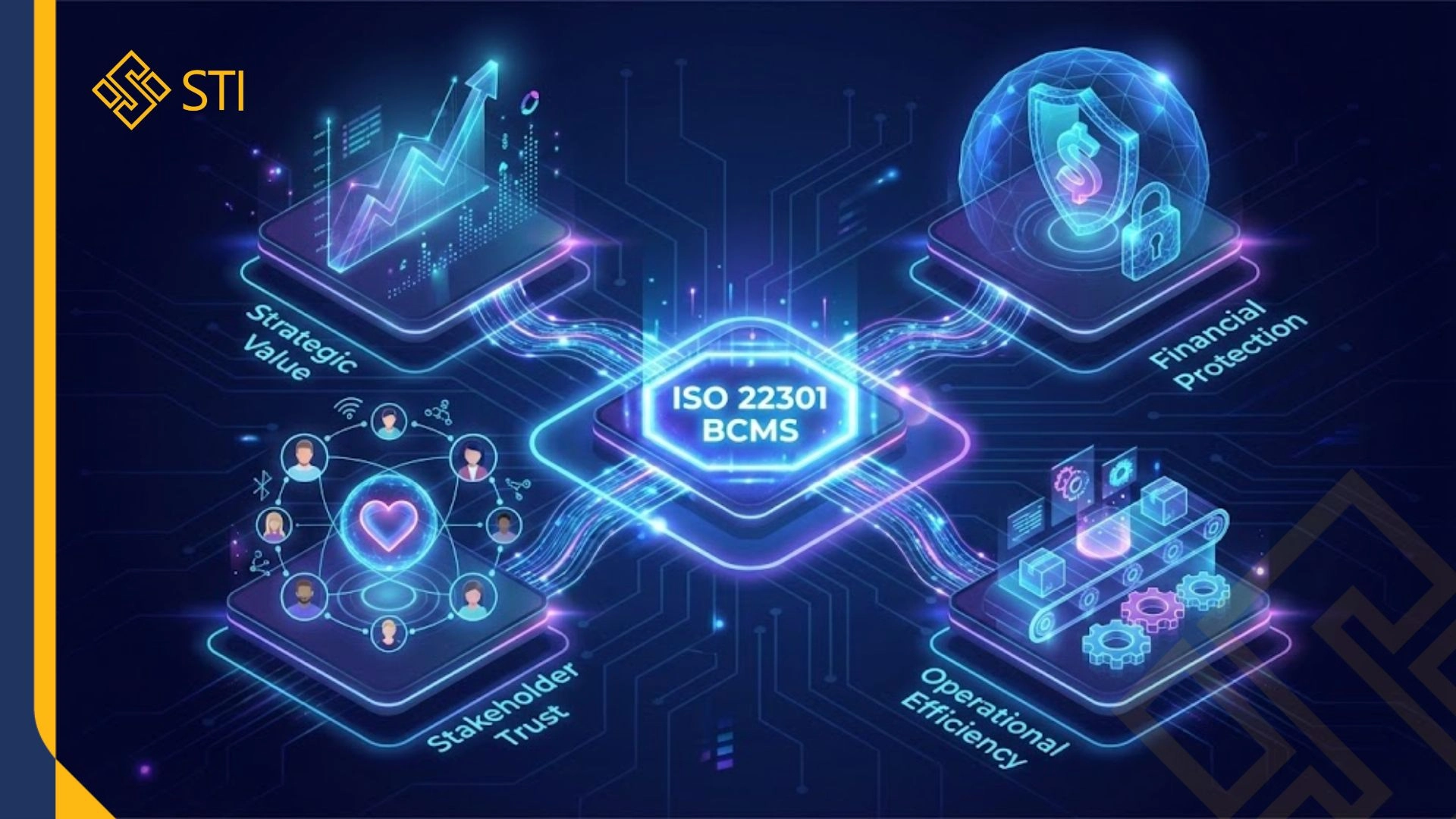
Benefit of application of ISO 22301
Business perspective
A BCMS helps organizations align operational planning with strategic objectives, ensuring that disruptions do not affect long-term development direction. When resilience is strengthened, organizations can maintain competitive advantage while protecting and enhancing brand reputation in the eyes of customers, partners, and the market.
Financial perspective
One of the most evident benefits of ISO 22301 is the reduction of financial losses. A BCMS enables organizations to identify risks early and prepare response plans to prevent prolonged disruptions. As a result, both direct and indirect costs are reduced, while the risk of legal violations or revenue loss is minimized.
Stakeholder perspective
A BCMS provides reassurance to customers, employees, investors, and the community. Organizations are better able to protect lives and assets, as well as minimize negative impacts on the environment and society. Maintaining continuous operations not only meets stakeholder expectations but also builds strong trust in the organization’s professionalism and responsibility.
Internal process perspective
A business continuity management system enhances an organization’s operational capability even during crises. Through continuous monitoring, evaluation, and improvement, organizations can proactively control risks, address process weaknesses, optimize performance, and strengthen management capability.
Thus, the benefits of ISO 22301 extend beyond risk management, contributing to stakeholder trust and improved operational effectiveness. All of these values form a solid foundation for sustainable business development.
Conclusion
It can be affirmed that ISO 22301 is not merely an international certification, but a key tool for organizations to enhance resilience, proactively manage risks, and pursue long-term sustainable development. Organizations that successfully implement a BCMS will not only survive crises but also gain opportunities to grow stronger and reinforce their position in today’s highly competitive market.
Sign up for consultation now
Leave your information to get free consultation about ISO 9001
ISO 31000: Comprehensive risk management solution for enterprises
In a changing and uncertain business environment, every organization faces risks that may hinder or even divert its objectives. To survive and achieve sustainable development, enterprises require a comprehensive and systematic approach to risk management. ISO 31000 – the international standard for risk management – provides organizations with a framework to proactively control risks, address uncertainty, and build trust with stakeholders.
What is ISO 31000?
ISO 31000 is an international standard on risk management (Risk management – Guidelines) issued by the International Organization for Standardization (ISO). The standard provides guidance for organizations to identify, assess, treat, and monitor risks arising during operational activities, with the aim of minimizing negative impacts, seizing opportunities, and supporting the achievement of business objectives.
According to ISO 31000:
- Risk is the effect of uncertainty on objectives. This effect may be positive, negative, or both.
- Risk management is the coordinated activities to direct and control an organization with regard to risk.
 Principles, framework and process of ISO 3100
ISO 31000 consists of three core components:
- Risk management principles, emphasizing integration, customization, and continual improvement.
- Risk management framework, which helps organizations establish structures, roles, responsibilities, and necessary resources.
- Risk management process, including the following steps: communication and consultation, establishing the context, risk assessment, risk treatment, monitoring and review, and reporting.
A key feature of ISO 31000 is that it considers risk management as an integral part of governance and decision-making, applicable at both strategic level and at the level of individual projects, products, or processes.
Why is ISO 31000 important?
ISO 31000 is important primarily because it establishes a global and consistent framework for understanding and managing risk. In a context where risks are increasingly complex, multidimensional, and difficult to predict, organizations may easily fall into a reactive approach. ISO 31000 enables organizations to adopt a standardized mindset and methodology, transforming risk management from an ad hoc activity into a core element of governance.
The standard is also important because it provides a common language for risk. When all levels of the organization—from top management and employees to partners—use shared concepts and approaches, coordination becomes more effective and transparent. This forms the basis for organizations to address uncertainty in a consistent manner.
In addition, ISO 31000 does not impose a rigid model but emphasizes flexibility and integration. It is applicable to all types of organizations, from small enterprises to multinational corporations, and can be applied at strategic, project, or day-to-day operational levels. This adaptability makes ISO 31000 a valuable tool in an environment of continuous change.
Finally, ISO 31000 is widely recognized as an international reference standard. As a result, organizations can align with global governance practices and facilitate cooperation, investment, and international integration.
Which enterprises is ISO 31000 suitable for?
ISO 31000 can be applied throughout the entire life cycle of an organization, from start-up and operation to expansion. The standard is suitable for all types of activities, including decision-making at all levels, from strategic management to project management and daily operations.

Turning risks into opportunities for growth with ISO 31000
ISO 31000 is particularly suitable for enterprises that aim to:
- Manage risk in an effective, consistent, and systematic manner.
- Establish and achieve both short-term and long-term objectives.
- Continuously improve performance and operational quality.
- Proactively respond to internal and external factors that create uncertainty.
Benefits of applying ISO 31000
Applying ISO 31000 – risk management guidelines not only helps organizations respond effectively to risks but also enables them to turn risks into opportunities for development. It serves as a strategic tool to enhance control capability, optimize performance, and establish a foundation for sustainable growth.
Enhancing risk anticipation and prevention
ISO 31000 supports organizations in building a structured risk management system, enabling early identification and anticipation of potential risks. This allows proactive prevention and mitigation of negative impacts before risks materialize.
Reducing financial, reputational, and legal losses
Effective risk management helps enterprises limit economic losses, avoid legal non-compliance, and protect brand reputation. This is particularly critical in sectors with high levels of risk.
Building trust with customers, partners, and investors
A transparent risk management system demonstrates organizational professionalism and responsibility. This strengthens trust, improves customer confidence, and attracts cooperation from partners and investors.
Improving strategic decision-making
With comprehensive risk information and analysis, leadership can make more accurate, timely, and well-informed strategic decisions aligned with long-term development objectives.
Enhancing competitiveness in international integration
ISO 31000 is an internationally recognized standard. Its application enables Vietnamese enterprises to enhance credibility, meet stringent international market requirements, and strengthen sustainable competitiveness.
Conclusion
ISO 31000 serves as a guiding reference for risk management in modern organizations, enabling enterprises to establish structured and flexible systems for risk prevention and response. By embedding risk management principles, processes, and culture into business strategy, leaders and managers can improve governance effectiveness, optimize operational performance, strengthen brand image, and expand market presence. Therefore, selecting appropriate consultancy services to implement this standard represents a strategic step that enables enterprises not only to survive but also to grow strongly in an increasingly competitive environment.
Sign up for consultation now
Leave your information to get free consultation about ISO 9001
ISO 31010: Comprehensive guidance on risk assessment techniques for organizations
In a market context characterized by continuous change and ongoing challenges ranging from politics and technology to competition, risk management has become a key factor for the survival and development of all organizations. The International Electrotechnical Commission (IEC) and the International Organization for Standardization (ISO) have cooperated to develop a comprehensive set of risk management tools, notably ISO 31010—an international standard on risk assessment techniques—updated to support organizations in preparing for, responding to, and recovering more effectively from risks.
What is ISO 31010? An essential risk management standard
ISO 31010 is an International Standard specializing in Risk management – Risk assessment techniques. It is an important supporting document for the ISO 31000 standard on risk management, providing detailed guidance on how to select and apply risk assessment techniques across a wide range of situations.
The ISO 31010:2019 edition not only introduces readers to a broad set of risk assessment techniques, but also provides specific references to other international standards for more detailed descriptions of their concepts and applications. This standard describes a structured process for risk assessment, from scope definition to report distribution, enabling organizations to identify and better understand risks in both business and technical contexts.

Risk management tools developed under IEC and ISO standards, including ISO 31010, represent good practice and international benchmarks for risk management, providing a unified management framework with clear principles and processes.
Key features of ISO 31010:
- Detailed specification of the processes for planning, implementation, checking, and validation of the practical value of applying techniques.
- Significant expansion in both the number of risk assessment techniques and their scope of application.
Why is ISO 31010 important for organizations today?
ISO 31010 plays an important role in the modern business environment because it provides a comprehensive framework and practical techniques that enable organizations to:

- Improve understanding of risk: Systematize the identification, analysis, and evaluation of potential risks.
- Support decision-making: Provide reliable information to support strategic and operational decisions under conditions of uncertainty.
- Enhance resilience: Help organizations prepare for, respond to, and recover more effectively from incidents and disruptions.
- Ensure compliance: Support organizations in meeting legal, regulatory, and industry standard requirements related to risk management.
- Improve operational performance: Optimize the use of resources and reduce losses caused by risks.
Who should apply ISO 31010?
ISO 31010 has a broad scope of application and is suitable for multiple user groups:
- Any individual or function involved in risk assessment or risk management within an organization.
- Those developing guidance on how to assess risk in specific contexts.
- Individuals who need to make decisions under uncertainty, including those who delegate authority, review risk assessments, need to understand assessment results, or must select assessment techniques appropriate to specific needs.
- Organizations that are required to perform risk assessments for compliance or conformity purposes will benefit from the use of these formalized and standardized risk assessment techniques.
Initially, many risk assessment techniques were developed in engineering contexts; however, their application has now expanded significantly to financial, managerial, and other contexts, including the consideration of both positive and negative outcomes of risk.
Benefits of applying ISO 31010 in organizational risk management
Implementing ISO 31010 provides a range of practical benefits that contribute to enhancing risk management capability and overall organizational performance:

- Provision of objective and transparent information for decision-makers.
- Improved understanding of uncertainty, risks, and opportunities, along with their potential impacts on objectives and success.
- Support for systematic identification, analysis, and evaluation of risks, thereby clearly defining risk treatment needs.
- Enablement of risk quantification or ranking to support prioritization of response measures.
- Contribution to improved understanding of risks to support the selection of treatment methods and cost-effective options.
- Identification of key drivers of risk and weaknesses within systems and organizations.
- Ability to compare risks across systems, technologies, or alternative approaches.
- Clear identification and communication of uncertainties, risks, and opportunities to stakeholders.
- Support for establishing priorities related to health, well-being, and safety in the working environment.
- Rationalization of the basis for maintenance and preventive inspection, reducing incidents.
- Improvement of investigation and post-incident prevention processes.
- Diversification of options for different forms of risk treatment and mitigation.
- Assurance of compliance with regulatory and legal requirements.
- Provision of important information to assess risk acceptability when compared against predefined criteria.
The application of ISO 31010 not only supports organizations in addressing risks effectively but also serves as a lever for building resilience, promoting sustainable growth, and achieving strategic objectives in a challenging environment.
Conclusion
In summary, ISO 31010 is not merely a collection of risk assessment techniques, but a strategic reference for organizations. In a dynamic business context, applying this standard helps organizations shift from a reactive approach to a proactive management of uncertainty. By providing a systematic methodology for identifying threats and recognizing opportunities, ISO 31010 serves as a solid foundation that enables organizations not only to operate effectively but also to build competitive advantage and pursue sustainable development.
Sign up for consultation now
Leave your information to get free consultation about ISO 9001
ISO 37000: International standard on organizational governance
In a global economic context characterized by ongoing change, organizations are facing increasing pressure regarding transparency, accountability, and ethical conduct. Expectations from stakeholders—from investors and employees to customers and communities—require a systematic and principle-based approach to governance. To address this need, the International Organization for Standardization (ISO) issued ISO 37000:2021, Governance of organizations — Guidance. This is the first international standard to provide a comprehensive framework to support organizations in establishing and maintaining good governance as a foundation for long-term success.
What is ISO 37000?
ISO 37000 is the first international standard to establish benchmarks for good governance, applicable to organizations of all types and sizes. This standard provides guidance on organizational governance by defining conditions, principles, and recommendations for key aspects of practice.
As a guidance standard, ISO 37000 supports organizations in making responsible decisions, building trust with stakeholders, and achieving sustainable success by aligning governance practices with globally recognized good practices.

Why is ISO 37000 important for organizations?
Corporate governance is the system of rules, practices, and processes by which a company is directed and controlled. Corporate governance emphasizes transparency, accountability, and fairness in order to serve the interests of all stakeholders.
In today’s increasingly complex business environment, effective corporate governance plays an important role in building trust, ensuring accountability, and promoting sustainable growth. Good governance helps ensure that organizations operate ethically, responsibly, and in alignment with the interests of stakeholders such as shareholders, employees, customers, and communities.
An effective governance system promotes transparency, accountability, and fairness—key factors in maintaining investor confidence and protecting organizational reputation. Good governance also helps reduce risks, avoid scandals or legal issues, and ensure sustainable development and long-term organizational success.
The application of ISO 37000 helps organizations strengthen governance structures, promote responsible leadership, ethical conduct, and effective operational performance.
Intended users of ISO 37000
ISO 37000 applies to all organizations, regardless of type, size, location, structure, or purpose.

This guidance is intended for governing bodies and management groups, but may also be useful to those who support them in carrying out their responsibilities, such as:
– human resources
– governance practitioners
– other interested stakeholders
Organizations using this guidance will be better equipped to understand stakeholder expectations and to apply the creativity, culture, principles, and performance necessary to achieve organizational objectives in accordance with purpose and values.
Benefits for organizations when applying
ISO 37000 certification demonstrates competence in the principles of good governance and affirms a commitment to promoting ethical conduct, accountability, and responsible leadership. Achieving ISO 37000 certification enables you to:

- Affirm a position as a specialist in the field of organizational governance
- Demonstrate comprehensive knowledge of governance principles and frameworks in accordance with ISO 37000
- Demonstrate the capability to implement governance structures that promote ethical decision-making
- Apply ISO 37000 practices to enhance transparency, accountability, and organizational resilience
- Recognize the importance of aligning governance with stakeholder interests and long-term objectives
- Enhance career opportunities by guiding organizations toward responsible governance and sustainable development
Conclusion
ISO 37000 represents an important milestone in shaping how organizations are governed in the current era. It is not merely a standard, but also a proactive governance approach that contributes to the development of a more equitable and sustainable society. Attention to social responsibility and transparency can help organizations overcome current challenges, while preparing for opportunities in the future
Sign up for consultation now
Leave your information to get free consultation about ISO 9001
ISO 37301 – Standard for Compliance management systems
In an increasingly complex legal environment, credibility and transparency are vital factors, making the establishment of an effective compliance management system a prerequisite for sustainable business development. ISO 37301 is a comprehensive solution that helps organizations not only comply with the law but also enhance integrity, credibility, and competitiveness in the market.
What is ISO 37301? An overview of this international compliance management standard.
ISO 37301 is an international standard for Compliance Management Systems (CMS), published in 2021 by the International Organization for Standardization (ISO). This standard provides requirements and guidance for businesses to establish, maintain, and improve an effective compliance system that can be certified by a third party.
A key feature of ISO 37301 is that the standard was developed based on the PDCA cycle (Plan – Do – Check – Act), which helps businesses continuously improve:
- Plan: Define requirements, risks, and compliance objectives.
- Cause: Implementing policies, procedures, training, and allocating resources.
- Check: Monitoring, measuring, and evaluating the effectiveness of the system.
- Act: Implement improvements, correct deviations, and enhance performance.
With this approach, ISO 37301 not only helps businesses meet legal requirements but also lays the foundation for sustainable development, enhancing credibility and building trust with customers, partners, and stakeholders.
Why is ISO 37301 important?
ISO 37301 is not just a compliance standard, but also a foundation for modern governance, especially important in a global context emphasizing transparency, social responsibility, and sustainable development.
Reasons why ISO 37301 is necessary:
- Building a culture of compliance: Making compliance a daily practice throughout the organization, ensuring transparency and fairness.
- Affirming credibility and management capabilities: This serves as international evidence that the business acts ethically and reliably.
- Minimizing legal risks: This provides a basis for demonstrating good faith before regulatory authorities, helping to mitigate penalties in the event of violations.
- Global integration: ISO 37301 is the “passport” for businesses to participate in supply chains and access international partners.
- Management system integration: Easily combined with other standards such as ISO 9001, 14001, 45001…
- Affirming social responsibility: Creating a competitive advantage as customers and partners increasingly prioritize transparent and sustainable businesses.
What types of businesses are ISO 37301 suitable for?
ISO 37301 is designed to be widely applicable and suitable for all types of organizations:
- Scale and scope of operations: This standard applies to all organizations, regardless of type, size, and nature of operations.
- Economic sectors: ISO 37301 is suitable for organizations in the public, private, or non-profit sectors.
- Business characteristics: The requirements and guidance in this document are adaptable. Implementation may vary depending on the size and maturity of the compliance management system, the context, nature and complexity of the organization’s operations, and its objectives.
- Large or multinational organizations: This standard is useful for organizations that are part of a larger entity, helping to define the geographical or organizational boundaries to which the compliance management system will apply.
Key benefits of implementing ISO 37301 in an organization
Implementing ISO 37301 brings many practical benefits to businesses in terms of management, performance, and brand image:
- Enhance compliance management capabilities: Effectively control legal obligations and internal regulations.
- Minimize risks and costs: Limit administrative penalties, reputational damage, and expenses resulting from violations.
- Enhanced operational efficiency: Helps organizations respond quickly and address compliance issues systematically.
- Strengthening reputation and brand: Affirming the image of an honest and trustworthy business.
- Increase confidence from stakeholders: Meet the expectations of customers, investors, and employees.
- Gaining a competitive advantage: ISO 37301 certification demonstrates management competence, helping you stand out in bidding and collaborations.
- Promoting sustainable development: Integrating compliance with risk management to optimize resources and achieve long-term growth.
- Third-party verification: ISO 37301 certification provides transparency and legal validity when verification is needed.
Conclude
In an era where transparency and integrity are the measures of business value, ISO 37301 has become an indispensable tool for building a comprehensive compliance management system. Adopting this standard not only helps businesses control risks, enhance reputation and operational efficiency, but also opens up many opportunities for cooperation, investment, and sustainable development. It can be said that ISO 37301 is a solid foundation for businesses to assert their position and maintain a competitive advantage in the global business environment.
Sign up for consultation now
Leave your information to get free consultation about ISO 9001