CE certification has long been regarded as a “passport” for construction material products to access the European market. This is not only a mandatory legal requirement, but also evidence of product quality, safety, and enterprise credibility. However, in practice, many Vietnamese construction material enterprises fail in obtaining CE certification due to a lack of experience and insufficient preparation. This article identifies three of the most common mistakes and introduces a comprehensive solution from STI Viet Nam, a professional consultancy and training organization in the field of CE.
In reality, many construction material enterprises underestimate the complexity of the CE certification process when first approaching it. As a result, they easily make mistakes that may appear minor but lead to the rejection of the entire dossier or require the process to be restarted from the beginning. The following are three typical mistakes that enterprises commonly encounter when pursuing this certification.
Mistake 1: Incomplete or incorrect technical documentation
Technical documentation is the most important foundation of the CE certification process and can be compared to a product’s “identity file”. It includes design drawings, technical specifications, manufacturing processes, test documentation, instructions for use, and related records.
However, in practice, most Vietnamese construction material enterprises do not prepare this documentation in a complete and correct manner. Some enterprises prepare only design drawings and manufacturing processes but omit test reports from independent laboratories. Others submit English-translated dossiers that are superficial and lack annotations in accordance with EN standards, resulting in rejection.
Technical documentation of enterprises showing several errors
Common errors include:
-
Failure to update to the latest EN standard version: for example, EN 771 for masonry units has been revised, but enterprises still submit documentation based on outdated versions.
-
Lack of evidence of conformity: absence of raw material inspection certificates and mechanical or physical test results.
-
Disorganized structure: documentation lacks logical arrangement and does not follow the sequence required by the assessing authority, causing prolonged evaluation.
As a consequence, enterprises may lose 3–6 months solely for supplementation and revision. If contract negotiations are underway, such delays may lead to contract cancellation by partners. This is only the initial stage. Even when the documentation is complete, enterprises must still pass another stringent stage: product testing.
Mistake 2: Non-compliant product testing
One of the most stringent stages of CE certification is product testing. Europe requires construction material products to be tested in accredited laboratories. This step demonstrates that the product genuinely meets EN standards.
Non-compliant testing creates significant difficulties for enterprises
A common mistake is that enterprises rely solely on domestic TCVN test results. They assume these results are sufficient for dossier submission, but when compared against EN requirements, the products fail to comply. Examples include:
-
Cement: failure to meet 28-day compressive strength requirements under EN 197-1.
-
Construction steel: yield strength not compliant with EN 10080.
-
Bricks: water absorption values exceeding limits specified in EN 771.
In practice, some enterprises do not conduct internal pre-testing but directly submit products for external evaluation. If the product fails, enterprises incur both testing costs and additional time for producing new batches.
Direct consequences include:
-
Substantially increased costs due to re-testing.
-
Delayed or cancelled contracts due to failure to meet timelines.
-
Damage to enterprise credibility due to the inability to demonstrate product quality from the outset.
More concerning, however, is that many enterprises misunderstand or underestimate the entire CE process, which constitutes the most serious mistake.
Mistake 3: Misunderstanding or underestimating the CE process
This is a “critical” mistake frequently made by Vietnamese enterprises. Many managers still believe that CE is merely a certification “similar to domestic conformity certification”. They assume that preparing basic legal documentation is sufficient.
In fact, CE is a comprehensive conformity assessment process, including:
B1: Identification of applicable standards
B2: Review of processes and technical documentation
B3: Product testing
B4: Preparation of technical documentation
B5: Assessment at the manufacturing facility
B6: Affixing the CE marking to the product
The most serious error is failing to understand or ignoring the role of the Notified Body. This is an independent organization designated by the European Commission to assess conformity for products with higher risk levels. If a product falls into a category requiring a Notified Body but the dossier lacks its involvement, rejection is certain.
Another issue is that many enterprises focus solely on obtaining certification once, without establishing a production system to maintain long-term quality. During periodic inspections, if products no longer comply, the CE marking may be withdrawn.
The consequences of this mistake are not limited to financial loss or contract termination, but include long-term damage to credibility in the European market. Partners may perceive the enterprise as unprofessional and lacking knowledge of international regulatory practices, making trust difficult to restore.
Clearly, even a minor error in the CE process can cause an entire export plan to fail. What happens if an enterprise does not pass the CE assessment?
Consequences when enterprises fail CE certification
Failure to obtain CE certification is not simply a matter of “non-approval”. It leads to a series of consequences:
-
Loss of access to the EU market: without CE, products cannot be legally placed on this market.
-
Loss of contracts and partners: many signed contracts are cancelled due to failure to meet legal requirements.
-
Financial losses: enterprises incur re-certification costs, warehousing expenses, and loss of profit.
-
Decline in credibility: a single failure in CE certification may result in reduced brand perception among international partners.
For these reasons, experts consistently recommend that construction material enterprises prepare thoroughly before submitting CE certification applications.
How to overcome CE barriers effectively?
Enterprises seeking solutions to overcome barriers in CE certification implementation
Losses in contracts, finance, and credibility indicate that CE cannot be treated as a simple administrative procedure. What is required is a comprehensive solution, from documentation preparation to practical implementation at manufacturing facilities.
-
Early preparation: research and plan for CE certification as soon as export intentions arise.
-
Systematic investment: regard CE as a foundation for capability enhancement, not as a burden.
-
Collaboration with experts: select experienced consultancy organizations such as STI to avoid unnecessary costs and delays due to errors.
Comprehensive solutions from STI Viet Nam to support effective CE certification
STI Viet Nam is a consultancy and training organization specializing in CE certification and has accompanied many construction material enterprises domestically and internationally. The distinguishing feature of STI lies in not only providing theoretical guidance but also directly participating with enterprises at each step, from dossier development to quality control at manufacturing facilities.
Benefits of cooperation with STI
-
Time and cost savings through a clear and structured process.
-
Reduced risk of certification rejection.
-
Enhanced brand credibility in international markets.
-
Improved competitiveness, including in the domestic market.
Do not hesitate to contact our consultancy team to obtain further information on a pathway suitable to your needs.
Related Articles

Capacity building and promoting the Digital and Green Transformation for SME support units in Quang Tri

STI Vietnam co-organizes capacity building for SME support units in Thai Nguyen

STI Vietnam co-organizes in-depth training on the digital and green transformation for SME support units in Hanoi

STI Vietnam co-organizes training on the digital and green transformation for SME support units in Hai Phong
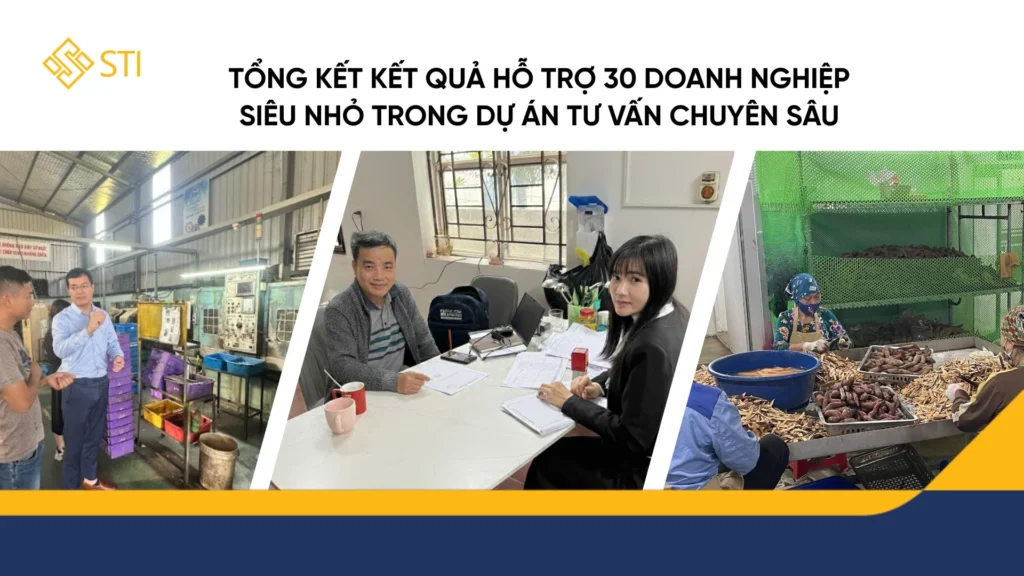
Project Outcomes: In-depth Consultancy Support for 30 Micro-enterprises