



Project expert providing guidance on assessment at Cao Nguyen Eye Hospital.
Two exemplary healthcare facilities in Gia Lai province have been selected to pilot the LEAN (Lean Management) model to improve the quality of medical services. Initially, the model has helped identify bottlenecks in operations, improve the working environment, and create positive changes in management thinking.
LEAN (Lean Management) is an improvement methodology originating from industrial production, now widely applied in many fields, especially in healthcare. The core of LEAN is eliminating waste that doesn’t create value, standardizing processes, shortening waiting times, and optimizing workflow. In a hospital environment, where the flow of patients, information, and services is constant, LEAN helps identify operational bottlenecks, improve patient experience, and enhance the efficiency of the healthcare team. Implementing LEAN in public healthcare facilities is a necessary step towards modernizing the primary healthcare system, focusing on the patient and aiming for higher quality service.
Within the framework of the provincial-level science and technology project “Building a model for improving productivity and quality based on the application of productivity improvement systems, standards, tools, and scientific, technological, and innovative solutions for businesses in Gia Lai province,” managed by the Gia Lai Provincial Department of Science and Technology and led by STI Vietnam Co., Ltd., the LEAN model – lean management – was selected for implementation at two medical facilities: Cao Nguyen Eye Hospital and An Khe Town Medical Center.
LEAN is considered one of the most modern and effective management methods currently available, particularly suitable for the healthcare sector – where minimizing waste, optimizing processes, and enhancing patient experience are top priorities. At Cao Nguyen Eye Hospital, the model was implemented with the direct participation of the board of directors and staff from various departments. Through a survey of the current situation, the hospital has initially applied 5S to improve the working environment, organize medical equipment neatly, and gradually identify waste in processes such as registration, dispensing medication, and payment. Some small changes have yielded noticeable results, such as adjusting the position of waiting chairs to reduce congestion, organizing medications by group, and applying the FIFO principle to minimize errors. Importantly, the hospital has begun building a value chain diagram in the medical examination and treatment process – one of the key tools of LEAN that helps to comprehensively understand the value flow provided to patients.
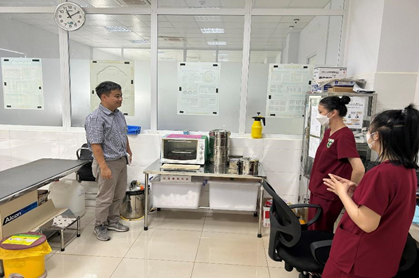
Beyond technical improvements, the hospital staff were also guided in conducting root cause analysis to address operational bottlenecks. Although there are still many challenges in synchronizing training, standardizing processes, and applying LEAN on a hospital-wide scale, the spirit of continuous improvement and the proactive approach of the hospital leadership have created a good foundation for maintaining and expanding the model in the future.
An Khe Town Medical Center – a public medical facility with 215 beds – is also one of the pilot models selected in this round. Here, the LEAN model is implemented in the outpatient, emergency, and pharmacy departments. Through surveys, the team of experts identified several areas for improvement, such as the poorly organized pharmacy, medical supplies placed directly on the floor, and the dispensing area not meeting the standards of being neat, clean, and convenient. Immediately afterward, the center began implementing activities to classify, label, and rearrange items according to functional areas and gradually cultivate 5S habits among its staff.
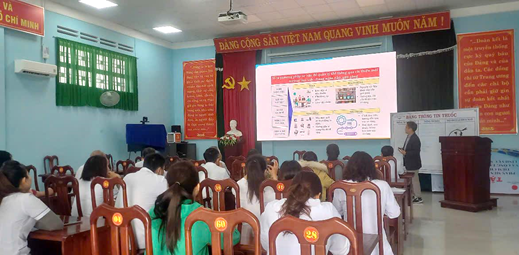
Notably, the center has proactively developed a visual patient reception flowchart in the examination area, helping people easily understand the process and minimize waiting times. Simultaneously, standard operating procedures (SOPs) have begun to be reviewed, updated, and illustrated with visual images, contributing to simplified procedures and reduced errors. Although the implementation of LEAN is still in its early stages, initial results show a shift in mindset and commitment from the management team to improving the quality of healthcare services.
The application of the LEAN model at two exemplary healthcare facilities clearly demonstrates the potential for significant improvement with the right support from specialized units. As a consultant and implementer, STI Vietnam Co., Ltd. has partnered with these healthcare facilities throughout the entire process of surveying, evaluating, and developing practical improvement plans. Their systematic and flexible approach, combining data analysis and real-world observation, has enabled the healthcare facilities to apply LEAN effectively and appropriately.
In the coming period, the Gia Lai Provincial Department of Science and Technology will continue to expand the LEAN model to other healthcare facilities, contributing to building a modern, efficient, and increasingly patient-centered public healthcare system. The initial success of these two pilot models is an important foundation for realizing that goal.
Related Articles

Capacity building and promoting the Digital and Green Transformation for SME support units in Quang Tri
Continuing the journey of propagating a sustainable productivity ecosystem from previous training courses, an in-depth training course on "Capacity Building...

STI Vietnam co-organizes capacity building for SME support units in Thai Nguyen
On April 16th and 17th, 2026, in Thai Nguyen City, STI Vietnam co-organized the training program "Capacity Building for SME...

STI Vietnam co-organizes in-depth training on the digital and green transformation for SME support units in Hanoi
On April 9th and 10th in Hanoi, STI Vietnam had the continued honor of collaborating with the Agency for Private...

STI Vietnam co-organizes training on the digital and green transformation for SME support units in Hai Phong
On April 2nd and 3rd in Hai Phong, STI Vietnam, in collaboration with the Agency for Private Enterprise and Cooperative...
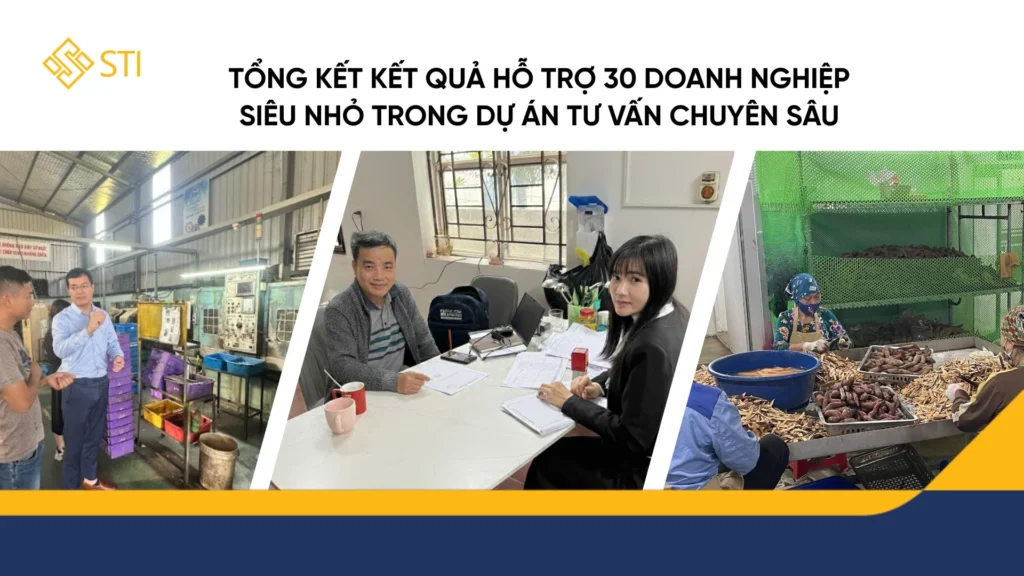
Project Outcomes: In-depth Consultancy Support for 30 Micro-enterprises
In the context where micro-enterprises account for a large proportion of the business community yet face numerous limitations in resources,...
STI accompanies TASA Group to achieve CE certification
In the realm of international commerce, few certifications possess the pervasive significance of the CE Marking. Often likened to a...