



ISO 22301 – Business continuity management system
In a business environment that is constantly exposed to risks and disruptions—from natural disasters and pandemics to technological incidents and supply chain interruptions—organizations need effective management solutions to maintain stable operations. ISO 22301 – Business continuity management system is the international standard that helps organizations establish, operate, and improve their resilience to crises. Implementing and achieving ISO 22301 certification not only supports businesses in rapidly recovering from incidents but also protects brand reputation, maintains customer trust, and ensures sustainable long-term development.
What is ISO 22301?
ISO 22301 is the international standard for Business Continuity Management Systems (BCMS), issued by the International Organization for Standardization (ISO). It provides a framework for organizations to plan, implement, operate, monitor, and improve management systems in order to protect against and reduce risks arising from business disruptions.
The current version, ISO 22301:2019, follows the high-level structure of Annex SL, enabling easy integration with other ISO management systems such as ISO 9001 and ISO 27001. The standard requires organizations to define their operational context, assess risks and opportunities, establish objectives, implement response and recovery processes, and conduct performance evaluation and continual improvement. Applying ISO 22301 helps enhance resilience, minimize financial losses, and maintain the confidence of customers, partners, and stakeholders in all situations.

From the above concept, it can be seen that ISO 22301 does not only set out requirements, but also provides a comprehensive framework to help organizations build and operate a business continuity management system (BCMS). To better understand this, it is necessary to examine the core components of a BCMS.
- Policy
- Competent personnel with clearly defined responsibilities
- Management processes related to:
- Policy
- Planning
- Implementation and operation
- Performance evaluation
- Management review
- Continual improvement
- Documented information to support operational control and enable evaluation of performance effectiveness.
However, understanding these components is only the first step. What is more important is understanding why ISO 22301 is necessary in a context where businesses face constant change and risk.
Why is ISO 22301 important?
ISO 22301 is important because it helps organizations establish and maintain a business continuity management system (BCMS) to minimize risks and ensure uninterrupted operations. The standard requires organizations to clearly identify needs and establish specific policies and objectives to guide management activities. As a result, organizations can operate and maintain processes, capabilities, and response structures to sustain operations even during incidents. Monitoring and evaluating BCMS effectiveness helps identify weaknesses in the system, providing a basis for improvement. When this process is carried out regularly, organizations enhance their resilience, protect brand reputation, and maintain customer trust in a highly volatile competitive environment.
Clearly, this standard provides a solid foundation for risk management. However, ISO 22301 is not only necessary for large corporations. So, which types of organizations are best suited to implement this standard?
Which organizations is ISO 22301 suitable for?
ISO 22301 is a widely applicable standard that can be implemented by any type of organization or by individual departments within an organization, regardless of size or industry. However, the level of implementation and degree of detail depend on the business context, operating environment, and complexity of each organization’s supply chain.
In practice, organizations operating in critical service sectors such as banking, insurance, healthcare, telecommunications, information technology, energy, transportation, and logistics are often recommended to apply ISO 22301, as the continuity and stability of their operations directly impact society and the economy. Organizations with multiple branches, extensive distribution systems, or heavy reliance on technological infrastructure also greatly benefit from this standard to reduce disruption risks.
In addition, organizations seeking to enhance brand reputation and meet stringent requirements from international partners and customers will find significant value in implementing ISO 22301. As such, this standard is suitable not only for large corporations but also for small and medium-sized enterprises with a sustainable development orientation and a desire to build resilience against crises.
Benefits of applying ISO 22301
Implementing a BCMS in accordance with ISO 22301 not only helps organizations maintain operations during disruptions but also creates sustainable strategic value. A well-structured business continuity management system delivers benefits across multiple dimensions:
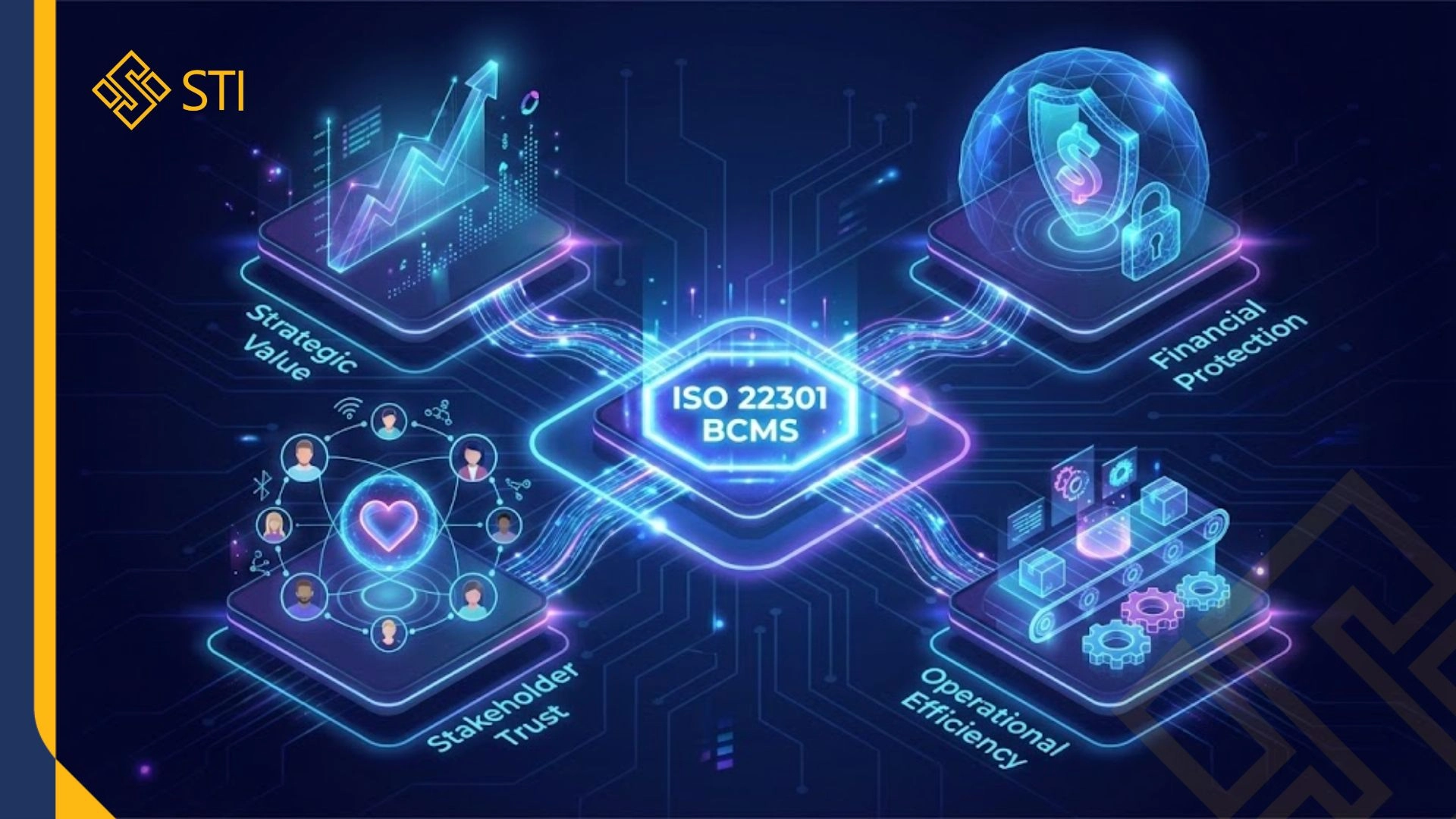
Benefit of application of ISO 22301
Business perspective
A BCMS helps organizations align operational planning with strategic objectives, ensuring that disruptions do not affect long-term development direction. When resilience is strengthened, organizations can maintain competitive advantage while protecting and enhancing brand reputation in the eyes of customers, partners, and the market.
Financial perspective
One of the most evident benefits of ISO 22301 is the reduction of financial losses. A BCMS enables organizations to identify risks early and prepare response plans to prevent prolonged disruptions. As a result, both direct and indirect costs are reduced, while the risk of legal violations or revenue loss is minimized.
Stakeholder perspective
A BCMS provides reassurance to customers, employees, investors, and the community. Organizations are better able to protect lives and assets, as well as minimize negative impacts on the environment and society. Maintaining continuous operations not only meets stakeholder expectations but also builds strong trust in the organization’s professionalism and responsibility.
Internal process perspective
A business continuity management system enhances an organization’s operational capability even during crises. Through continuous monitoring, evaluation, and improvement, organizations can proactively control risks, address process weaknesses, optimize performance, and strengthen management capability.
Thus, the benefits of ISO 22301 extend beyond risk management, contributing to stakeholder trust and improved operational effectiveness. All of these values form a solid foundation for sustainable business development.
Conclusion
It can be affirmed that ISO 22301 is not merely an international certification, but a key tool for organizations to enhance resilience, proactively manage risks, and pursue long-term sustainable development. Organizations that successfully implement a BCMS will not only survive crises but also gain opportunities to grow stronger and reinforce their position in today’s highly competitive market.